Posters and Foam Board Displays for Media and Creative Teams in Salford
Table of Contents
MediaCityUK was built for people like you. Salford City Council describes it as a purpose-built home for creative and digital businesses, and also as a prime events destination.
Walk round the Quays on a weekday and you'll see it. Lanyards. Laptops. Teams heading into pitches, screenings and workshops.
In a world that lives on screens, print can feel old-fashioned. But it isn't. A big board in a meeting room holds attention in a way a shared screen often doesn't. A poster on the wall reminds the whole team what they're building.
This guide is for creative studios, production teams and agencies. It covers foam board presentation boards, posters for pitches and showcases, banners for events, and how to plan your order so it all arrives before the big day.
What creative teams print
Every team is different, but these come up again and again.
- Pitch and presentation boards. For mood, concepts, storyboards and key frames.
- Posters. For screenings, shows, launches and the office wall.
- Banners. For events, panels and open days.
- Printed documents. Treatments, lookbooks and leave-behinds.
Inside the studio
Print isn't only for clients. Plenty of teams use it to keep themselves on track.
- A big project timeline on the wall, so everyone sees the same dates.
- Character sheets, style frames or brand guides pinned up where the team works.
- A wall of past work in reception, so visitors see what you do before you say a word.
Why print still matters in a digital world
- People remember it. A board on an easel stays in the room. A slide disappears with one click.
- It's shareable without a screen. Clients can walk up, point and talk.
- It shows care. Printed work says "we took this seriously".
Foam board presentation boards
Foam board is the go-to for presenting work in person. It's rigid, light, stays flat and looks clean. It's for indoor use, which suits meeting rooms, studios and showcases.
Pick your size
- An A1 foam board (594 x 841 mm) is the classic pitch board. Big enough to see across a meeting table, small enough to carry under one arm.
- An A0 foam board (841 x 1189 mm) makes a real statement. Use it for a hero image, a big storyboard or a final reveal.
How to build a set of pitch boards
- One idea per board. Don't cram three concepts onto one. Give each room to breathe.
- Order them like a story. Problem, idea, how it looks, how it works.
- Keep words to a minimum. You're there to do the talking. The board is the visual.
- Number them on the back. Small thing, but it stops a mix-up in the lift.
- Leave a blank board for the end. A simple board with your studio name and contact details is a calm way to close. It stays on show while people ask questions.
Getting them there safely
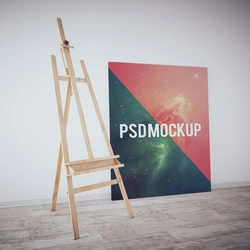
Foam board corners can dent if knocked. Carry boards face to face, with something soft between them, and keep them flat. Our foam boards are printed only, so if you need easels, check whether the client's office or the venue has some.
That's how pitch boards printing goes from "nice idea" to "they loved it".
Pitching at the client's office?
Not every pitch happens on your own turf. If you're presenting in someone else's building, plan for it.
- Ask how big the meeting room is. A0 boards can feel huge in a small room.
- Ask whether there's a wall, a ledge or easels to rest boards on.
- Arrive early enough to set up without rushing.
- Bring a soft bag or a large folder to protect boards on the way in, especially if it's raining by the water.
Little things like this make you look calm and prepared, which is exactly how you want a client to see you.
Posters for pitches and showcases
Production posters
Production poster printing covers lots of jobs. Posters for screenings, wrap parties, launches, end-of-project celebrations, or simply to put your latest work up on the studio wall.
- An A1 poster (594 x 841 mm) is perfect for a key art poster or a screening.
- An A2 poster (420 x 594 mm) suits corridors, kitchens and smaller walls.
Matching sizes across a series
A sizes all share the same shape. So a design made for an A2 poster can scale up to A1 or down to A3 without stretching. That makes it easy to create a matching family of posters for one project.
Showcase tips
- Show the work, not just the logo. A strong still says more than a list of credits.
- Use the same style across a series. If you're showing several projects, a matching layout makes it feel like a curated show.
- Check your files. Images that look sharp on screen can look soft when printed big. Use the highest quality version you have, set to the right size.
Leave-behinds
After a pitch, give the client something to keep.
- An A4 stapled brochure works well for treatments, lookbooks and capabilities documents.
- Stapled books are made from folded sheets, so the page count needs to be a multiple of four. Plan your layout around that.
- Keep it short and visual. It should remind them of the pitch, not repeat it word for word.
Pull-up banners for events
MediaCityUK hosts plenty of events, from talks to festivals to open days. If your team is taking part, a banner helps people find you.
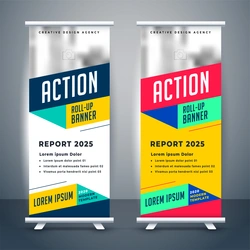
- A pull-up roller banner (800 x 2000 mm) stands about two metres tall on its own base.
- Use it behind a panel stage, next to a demo table or at the door of a screening room.
- It rolls back into its own base, so it's easy to take from event to event.
Running your own public event at MediaCityUK?
If you're planning to hold an event in the public spaces, Salford City Council has guidance on applying for events at MediaCityUK. Check it early, because permission can affect what you're allowed to put up and when.
Make it reusable
Leave dates and event names off. Studio name, a strong visual and a one-line description of what you do. Then it works for every event this year.
Check the event rules
If you're appearing at an event run by someone else, check their rules on banners and signs before you design. Some events have their own branding guidelines.
Keep your brand joined up
When your boards, posters, banner and brochure all share the same colours, fonts and layout style, it looks like one team made them. For an agency, that's the whole message: we pay attention to the details.
Order timeline
Here's how timing works for media team print sent to Salford.
- Standard UK shipping is 2 to 3 working days of production, then about 2 days for delivery.
- Working days are Monday to Friday.
- Same-day delivery is only for London and inside the M25, so plan for standard shipping.
| When | What to do |
|---|---|
| 3 weeks before | Lock in the creative. Decide which boards and posters you need. |
| 2 weeks before | Final artwork, set to the right size and checked at full size on screen. |
| 8 to 10 working days before | Place your order. |
| 2 to 3 days before | Everything delivered. Lay it out in order and do a run-through. |
| The day | Boards in order, brochures in a bag, banner ready. |
A pitch-day tip
Do one full run-through with the printed boards, not just the slides. Things look different in print. Better to find a typo on Tuesday than in front of the client on Thursday.
Treat these dates as a guide, not a promise. Creative deadlines move, so give yourself room.
Make your work look as good in the room as it does on screen
Strong foam board presentation boards, clear posters and a neat leave-behind help your ideas land. And in a pitch, landing the idea is everything.
Choose your sizes, upload your files and we'll print and send them to your studio. Questions? Call us on 020 7701 2515. You can also read more about our poster printing in Manchester City Centre, or see our page on poster printing in Salford and MediaCityUK.